Cutting no-shows at an independent restaurant
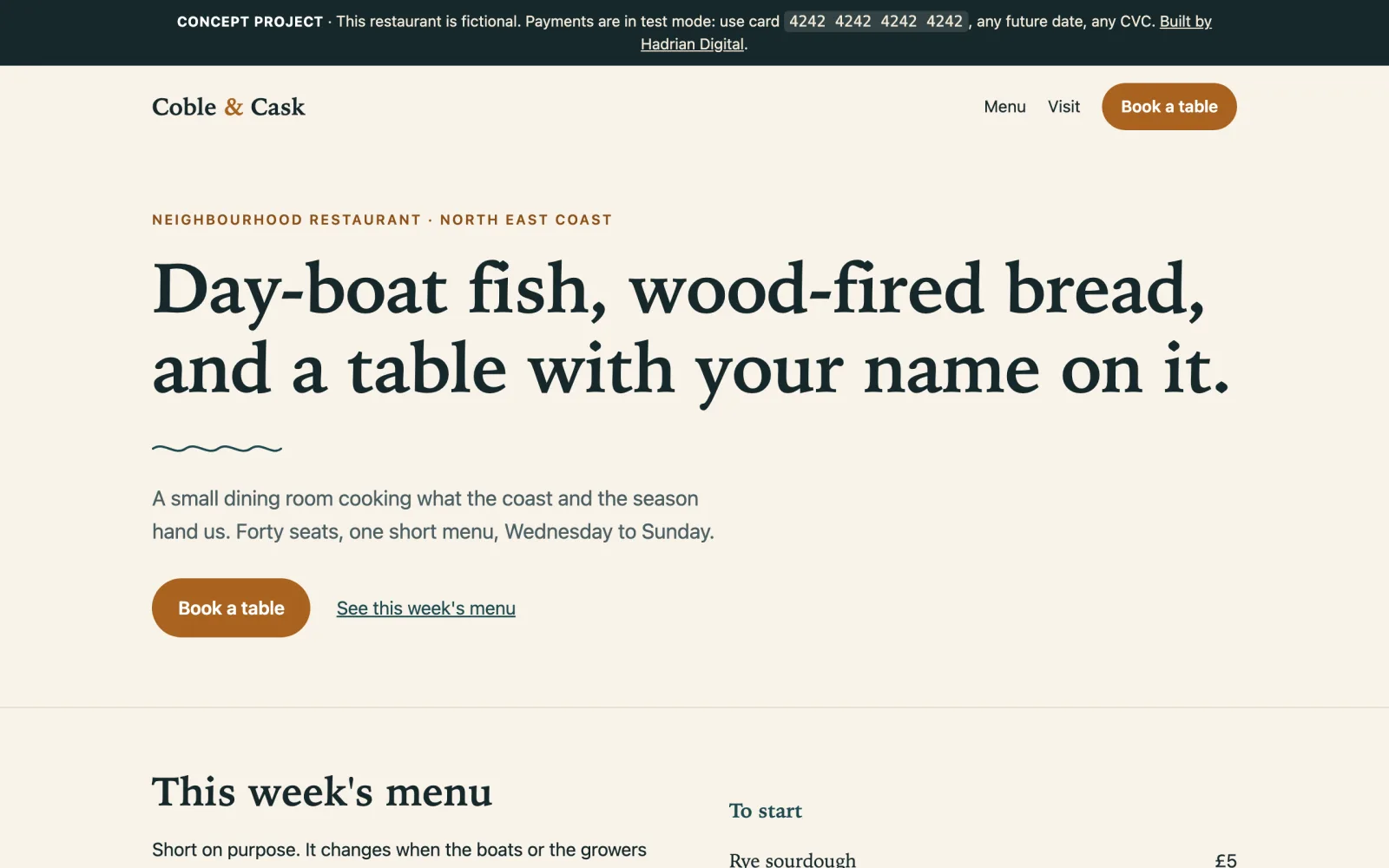
Coble & Cask is a restaurant I made up. The website is real and works: customers book a table, pay a deposit by card, and get a confirmation email, and the owner sees every booking on one page. I built it for my web design business, Hadrian Digital, and ran it the way I'd run a customer engagement.
- Customer
- The owner of a 40-seat independent restaurant. A composite of places I've worked, not a real client.
- Problem
- Tables booked by phone that never turn up, on the nights the restaurant can least afford it.
- Solution
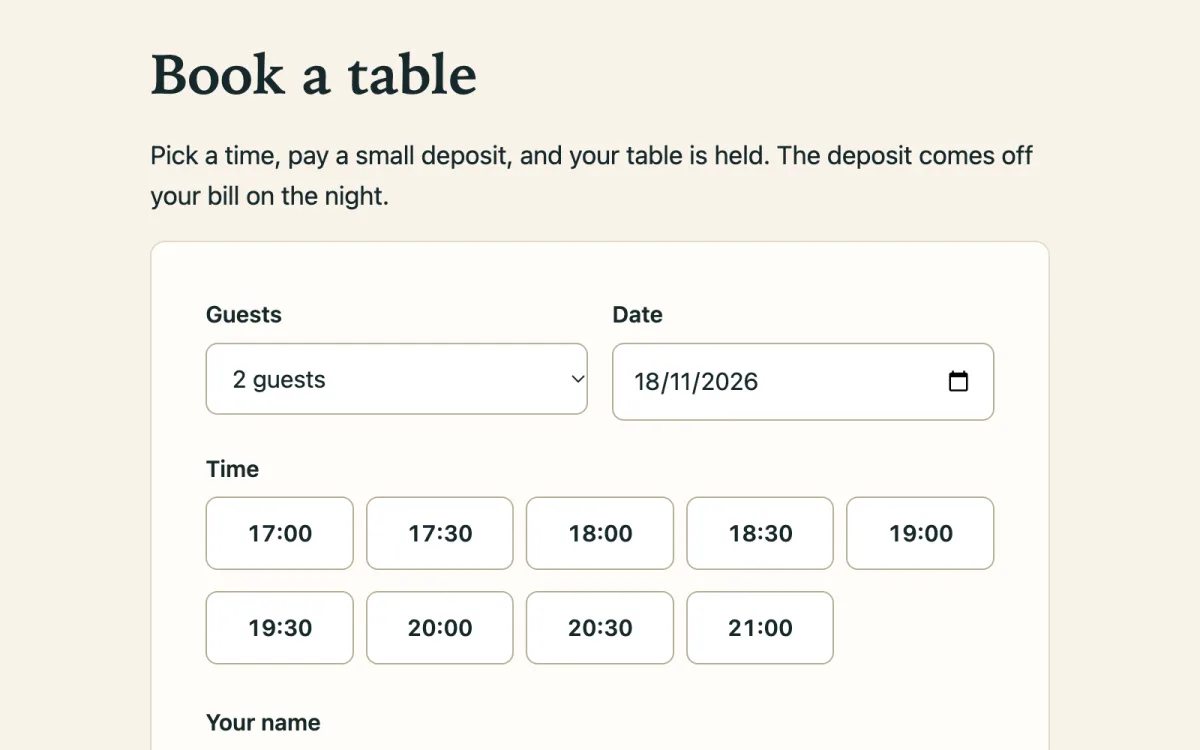
- Online booking on the restaurant's own site, with a card deposit taken at the time of booking.
- My role
- Everything: problem definition, design, build, testing and the pitch.
- Built with
- JavaScript, Node.js/Express, SQLite, Stripe Checkout, Resend
The customer's problem
I worked front of house at a restaurant in North Shields and took reservations behind a bar in South Shields. The pattern is the same in both. Bookings come in by phone, often in the middle of service, and go into a diary. A booking costs the customer nothing, so some of them don't come.
For a small dining room that is expensive in three ways:
- The table earns nothing. It was held, so walk-ins and later callers were turned away.
- The costs were already spent. Staff were on the rota and food was prepped for a full book.
- It lands on the best nights. A Saturday no-show can't be refilled at ten minutes' notice.
Because this is a concept, I had no real owner to interview. These are the questions I'd open discovery with, and the build assumes the answers a small owner-run restaurant is likely to give:
- How do bookings reach you today, and who writes them down?
- Roughly how many tables don't turn up in a normal week, and on which nights?
- What have you already tried? Reminder calls, a booking platform, a card number over the phone?
- Who would use the bookings page, and on what? A phone, or a tablet by the till?
- What would make you switch it off? This usually reveals the real objection.
Options considered
A deposit is not the only answer to no-shows, and for some restaurants it is the wrong one. I compared five approaches before choosing.
| Option | For | Against |
|---|---|---|
| Keep the phone and diary, add reminder calls | No cost, no change for customers. | Takes staff time every day. A reminder doesn't give anyone a reason to turn up. |
| A third-party booking platform | Quick to set up. Table management included. Some bring diners through their own listings. | An ongoing fee. The platform sits between the restaurant and its customers, and bookings happen on someone else's site. |
| Card details held, charged only on a no-show | No money leaves the customer unless they don't come. | The owner has to charge a customer after the fact, which invites disputes and awkward conversations. |
| A deposit on the restaurant's own site (chosen) | Commitment at the moment of booking. Money is already held. The restaurant keeps the customer relationship. | One more step when booking, so a few people will drop out. Card fees on each deposit. |
| Full prepayment for a set menu | The strongest commitment there is. | Only suits tasting menus and events. Too heavy for an ordinary Friday table. |
I chose the deposit because it changes the customer's behaviour before the night, not after it, and it never asks the owner to chase anyone for money. A restaurant that mainly wants more new diners should look hard at a platform instead. Saying so is part of the job.
Why this design
Stripe's payment page, not a card form on the site
Card details go straight to Stripe and never touch the restaurant's website. The owner takes on almost none of the card-security burden, and Apple Pay and bank verification work without extra code. The trade-off is a brief hop to another page, which I judged worth it for a business with no IT department.
The booking is confirmed by Stripe telling the server, not by the thank-you page
A customer can pay and close the tab before they are sent back. Stripe's server-to-server notification arrives either way, so a paid booking is never lost. The same notification can arrive twice, so confirming is safe to repeat and the email is sent once.
Seats are held while the customer pays
An unpaid booking holds its place for 35 minutes, then releases it. The check for free seats and the saving of the booking happen as one step, so two people can't take the last table in the same second.
One capacity number, not a table plan
The owner sets how many guests can arrive in each half hour. It is one number they already know in their head, and it protects the kitchen. A full table plan would fill the room more tightly but is far more to build and to keep up to date. It is the obvious next step for a busier venue.
The owner's page does two things well
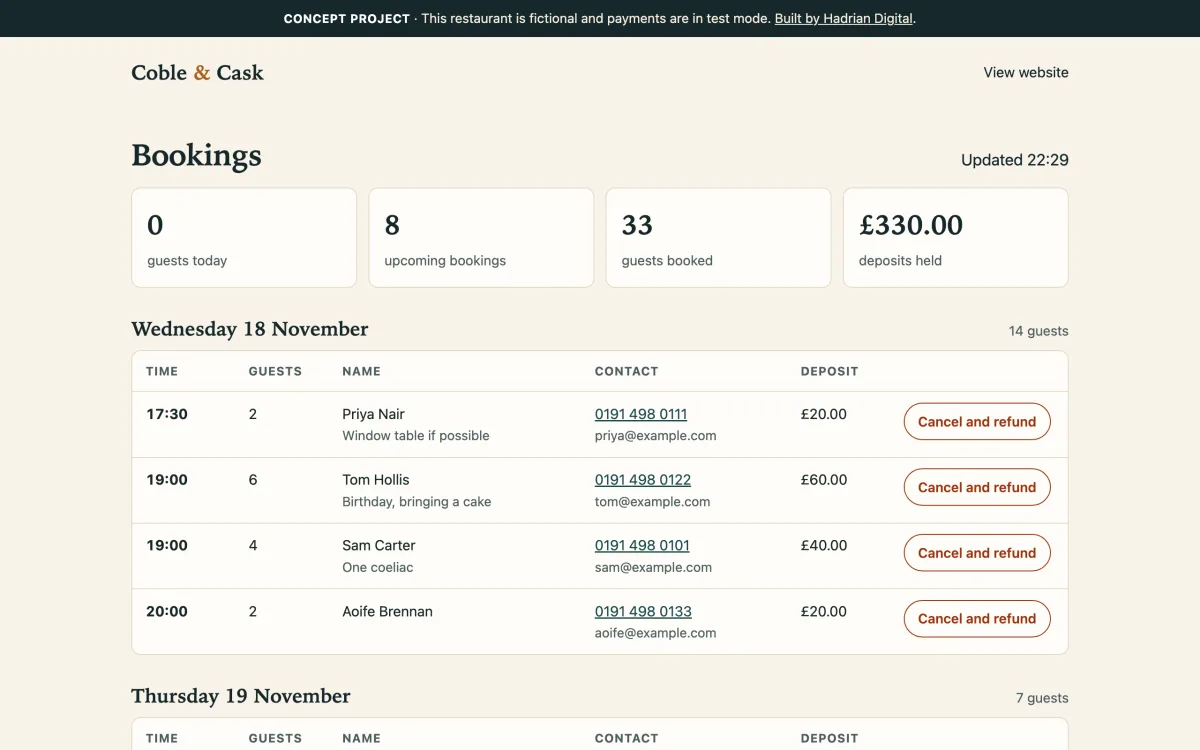
It shows today's covers and every upcoming booking by day, with notes such as allergies. It cancels a booking and refunds the deposit in one click, so the owner never needs to learn Stripe's dashboard.
Objections a buyer would raise
"A deposit will put my customers off."
Some, yes, and it is worth being honest about that. The deposit comes off the bill, it is refunded in full with 24 hours' notice, and both are stated before the customer pays. If it is still a worry, start with deposits only for large parties or weekend evenings and compare the two.
"What does it cost me per booking?"
Stripe takes a card fee on each deposit. I'd bring the current rate to the meeting and work it through against the value of one empty table for four, using the owner's own prices, not mine.
"What about a regular who genuinely can't make it?"
The owner decides. Cancel and refund is one click on the bookings page, whatever the notice. The policy is the default, and the owner's judgement overrides it.
"Half my bookings still come by phone."
That is a real gap in this version: the owner can't yet add a phone or walk-in booking from the bookings page, so the two would have to be kept in step by hand. It is the first thing I would build next, and I'd say so before being asked.
"I'm not technical. What happens when it breaks?"
There is nothing for the owner to install, update or log in to beyond one bookings page. If the email service fails, the booking still stands and the failure is logged. If Stripe can't be reached, the seats are released and the customer is asked to try again.
"Is my customers' data safe?"
The site stores a name, email, phone number and booking notes, and nothing about cards. The bookings page is behind a password. For a live restaurant I would add a privacy notice, a retention period for old bookings and individual staff logins.
"We already use a booking platform."
Then the question is what it costs and whether it takes deposits the way you want. If it works and the fee is fair, keep it. I would rather lose the sale than move someone off a tool that suits them.
What it doesn't do yet
- Customers can't cancel or change a booking themselves.
- No reminder message the day before.
- No phone or walk-in bookings from the owner's page.
- It has not been used by a real restaurant, so there are no results to report. The measure I'd track is no-shows per week before and after.
How I checked it works
Automated tests cover the booking rules and the database layer, including overbooking, expired holds and repeated confirmations. I also ran a full booking by hand in Stripe's test mode: payment, confirmation, cancellation and refund.